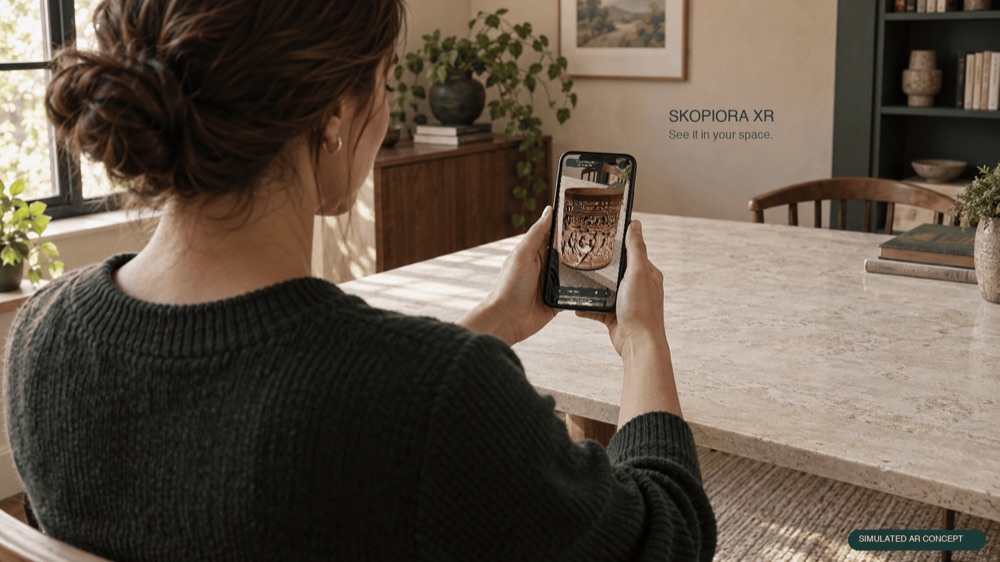
Skopiora XR: the Bitong experience
A web-based 3D and AR experience for a carved bamboo brush pot, opened from a QR code with no app install, built so that a small museum can reproduce the whole pipeline with free tools.
- ROLE
- Project direction, research and development
- OBJECT
- Bitong (brush pot), Spurlock Museum of World Cultures, object 2007.12.0006A
- BUILT WITH
- Python, Three.js, WebGL, a photographic panorama
- OUTPUT
- Annotated HTML viewer, GLB model, reproduction kit
The problem
Many museums want their objects to be explorable on a phone, but AR projects often depend on paid platforms, installed apps or specialist capture rigs. Small collections rarely have any of those.
Skopiora XR asks a narrower question: with one good panorama and a catalogue record, how far can a free, web-only pipeline go, and can another museum repeat it?
The experience
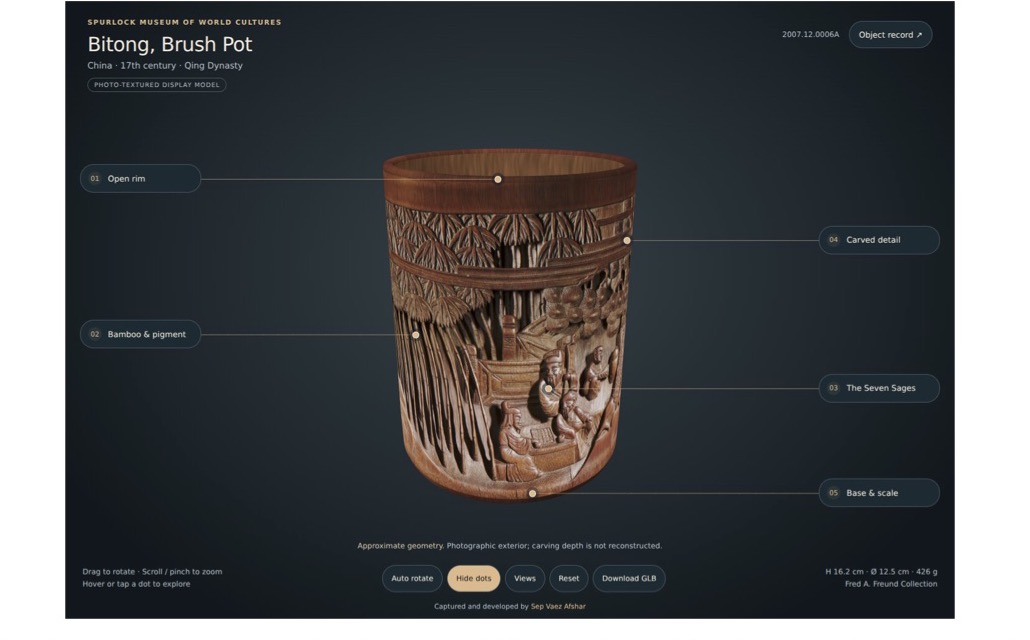
Visitors scan a QR code and open the object directly in the browser. Numbered hotspots mark the open rim, the bamboo and pigment, the carved detail, the Seven Sages scene and the base, and each one opens a short story without leaving the scene.
The bitong is a Qing-dynasty (17th century) piece from China in the Fred A. Freund Collection, about 16 cm tall. The viewer shows its catalogue number, dimensions and weight, lets you rotate and zoom, and offers a GLB download for reuse.
How it was made
A Python script builds an approximately rotationally symmetric display model and applies the object's photographic exterior from one supplied panorama; a self-contained Three.js viewer presents it with annotations.
I wrote the method up as a technical guide (version 1.1, October 2026) with a reproduction kit: the executable source, input panorama, catalogue record, generated outputs and validation reports. Implementation was done with an AI coding assistant under my direction, and the guide says so.
What it does not claim
Writing the limits into the viewer and the guide is part of the project: a museum should be able to see exactly what a visualization is evidence for.
Gallery