Beneath the Stone
A low-resource, text-based game that asks how digital heritage can represent marginalized histories without turning them into spectacle, in a form small organizations can host for free.
- ROLE
- Designer and developer
- ADVISOR
- Prof. Laura Shackelford, University of Illinois
- VENUE
- SIGraDi 2026; NCPE 2026 poster
- BUILT WITH
- One HTML file (HTML, CSS, JavaScript), Cloudflare hosting
The question
Heritage sites such as Mammoth Cave hold stories of Indigenous inhabitation, enslaved labor and commercial tourism. Digital experiences about them often rely on heavy 3D, recorded voices and invented faces, which can turn real people into spectacle and put the result out of reach of the communities and small institutions it concerns.
Beneath the Stone is the demonstration artifact for a design framework I wrote with Prof. Shackelford: can a deliberately small, text-only game carry an ethical argument about how heritage is represented?
What you play
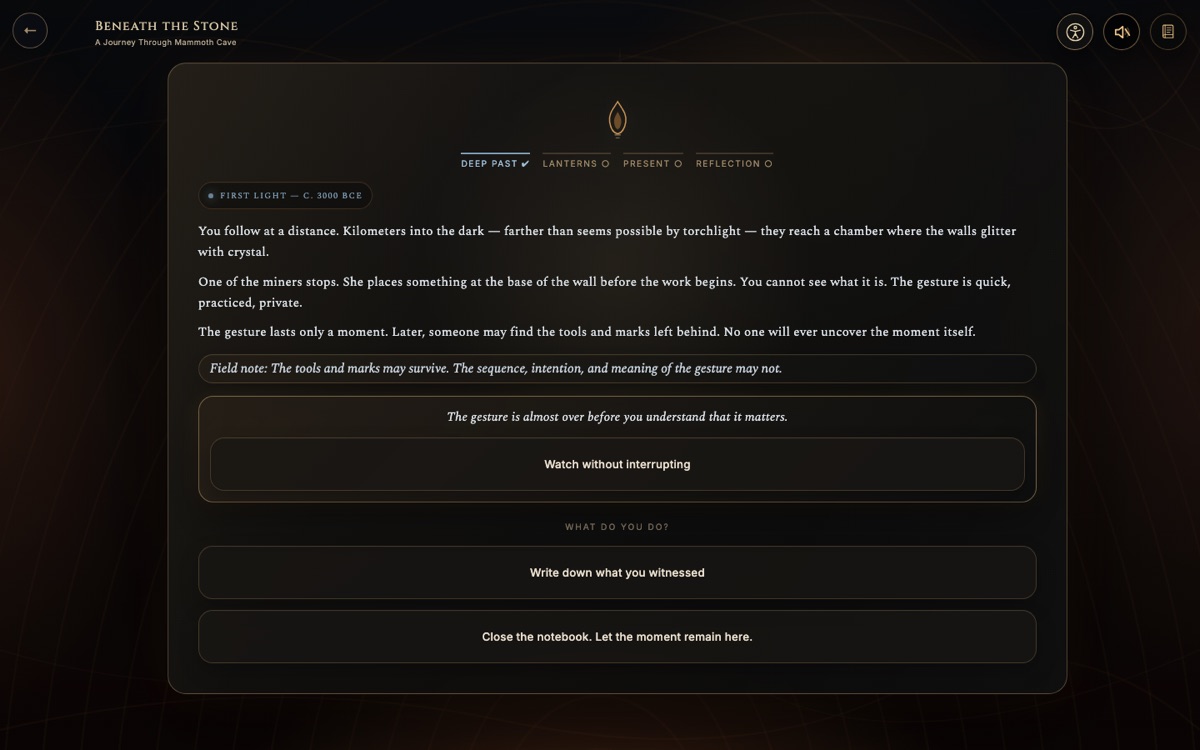
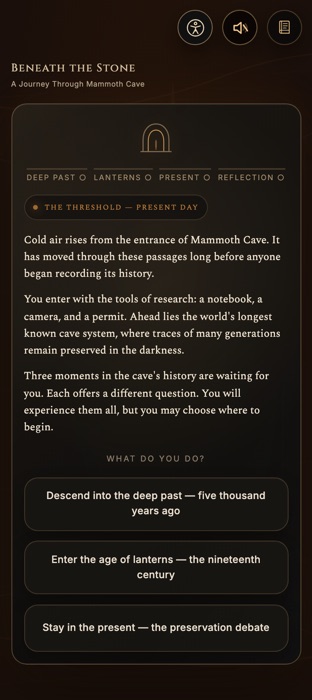
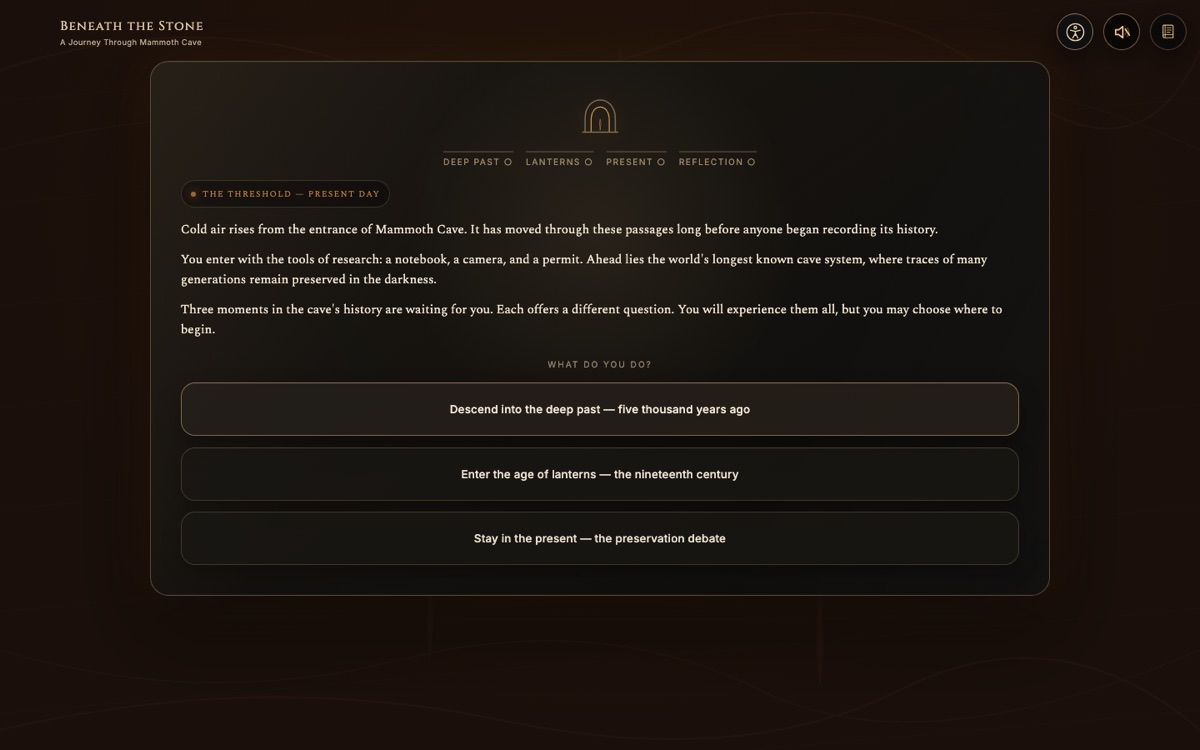
You are a visiting researcher moving through three ages of the cave: pre-contact Indigenous inhabitation around 3000 BCE, the lantern-lit commercial tours of the 1840s, and a present-day preservation meeting. The story is nonlinear.
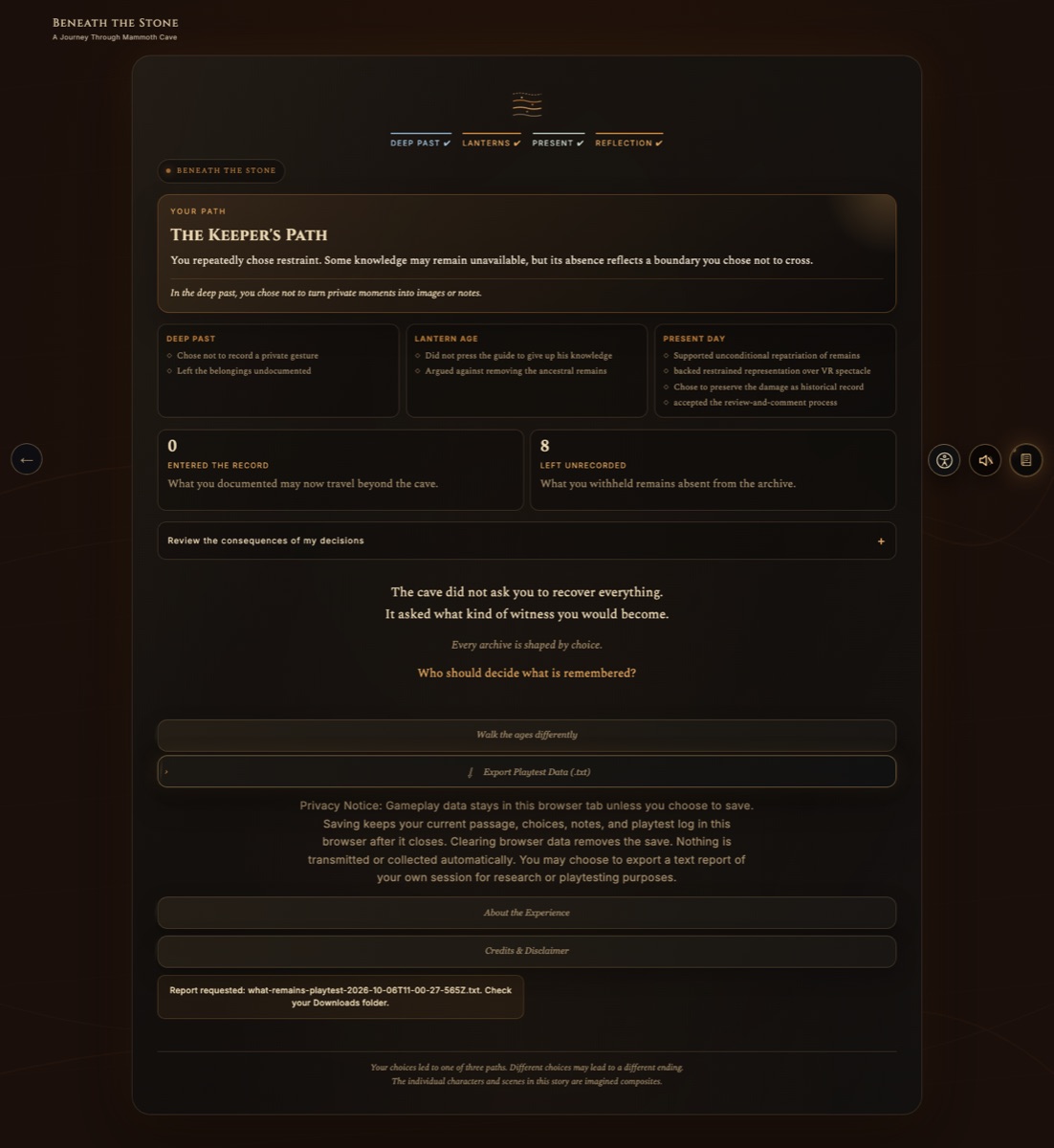
Eight tracked decisions about recording, sharing and preserving shape one of three ending reflections: the Archivist's Path, the Keeper's Path or the Steward's Path. There is no winning state; the game ends in a reflection on what you chose to record and what you left alone.
The framework behind it
The paper names four principles, and each one is something you can inspect in the game:
- Narrative sovereignty
- Constrained representation
- Player reflexivity
- Low-resource materiality
Low-resource materiality is the most concrete: the whole game is one HTML file with no images, no recorded audio, no external dependencies, no server and no data collection. That makes it easy to host, archive, translate and audit.
Built so the claims can be checked
Because a paper makes claims about a game, I wrote automated checks that test them: static checks compare the build against the claims in the paper, and a smoke test plays through all three endings and verifies that the game makes zero network requests.
- Accessibility: keyboard-only play, adjustable text size, a plain reading mode, reduced motion, optional sound that carries no required information, and no time limits.
- Privacy: nothing is transmitted. A session is saved in the browser only if the player chooses to, and an exported report is created only by the player's own click.
- Openness: code under MIT, narrative text and historical notes under CC BY-NC-SA 4.0.
Documented and invented
Places, artifact types and documented practices come from the archaeological and historical record. The characters, dialogue and specific incidents are imagined composites, and the game says so. It is an independent educational work and is not affiliated with Mammoth Cave National Park or the National Park Service.
Gallery